The history of political repression contains a recurring pattern: when authorities want to silence criticism, they do not always rely on arrest or overt violence.
Sometimes the objective is to make activism difficult without openly declaring that repression is taking place.
One of the clearest historical examples is Zersetzung, a system of covert repression used by the East German Ministry for State Security, the Stasi, against people and groups it considered politically hostile.
Zersetzung belongs to a particular historical period and political system. It should not be transplanted carelessly into the present.
But studying it is still valuable.
The Stasi developed detailed methods for weakening activist networks through surveillance, infiltration, isolation, reputation attacks, manipulation of relationships, rumors, psychological pressure and disruption of collective activity.
These methods are documented in surviving Stasi directives and operational files.
Today, technology has transformed the environment in which activism takes place.
Activists communicate through social-media platforms, encrypted messaging services, email, websites and cloud systems.
Their professional reputations, personal networks and public identities are often partly or almost entirely digital.
Contemporary human-rights organizations and European institutions document forms of repression that can operate through those same digital environments: spyware, hacking, doxxing, surveillance, online harassment, intimidation, blackmail, defamation and disinformation.
The tools are different.
The political systems involved may be different.
The legal circumstances may be different.
But some of the functional objectives can look familiar: isolate a person, damage their credibility, monitor their activity, intimidate them, interfere with their ability to organize, or make participation in public life more difficult.
That is the comparison this article explores.
What Zersetzung Actually Was
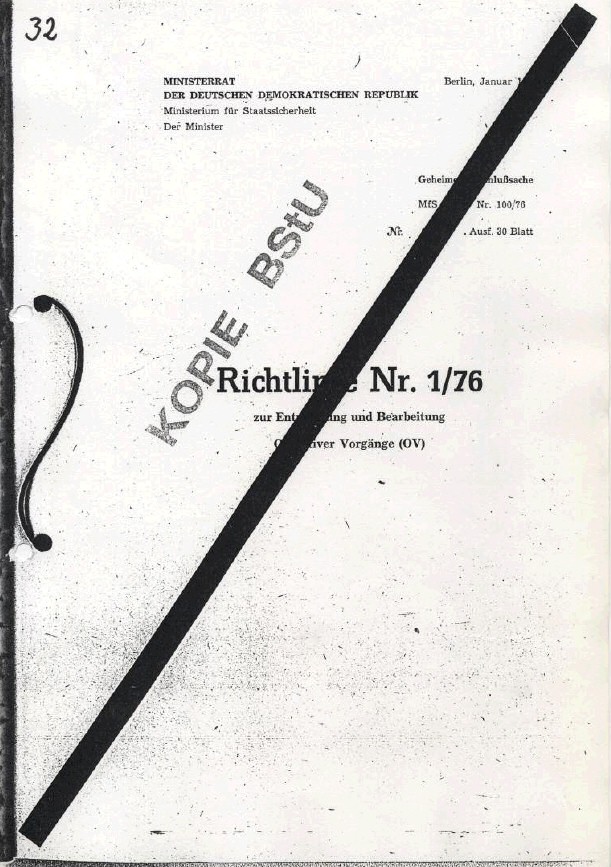
Cover page of the MfS guideline No. 1/76 on the development and processing of operational processes
Zersetzung was not simply a synonym for “harassment.”
It was a specific Stasi method of covert political repression.
The Stasi’s 1976 Directive 1/76 formalized Zersetzung as part of its operational work.
The surviving archival record shows that the objective included destabilizing, fragmenting, disorganizing and isolating people or groups considered hostile.
The Stasi Records Archive also preserves operational plans showing how the general concept was applied to particular activist groups.
One particularly clear case concerns the Pankow Peace Circle in East Berlin.
The group was established in 1981 under the umbrella of a church congregation.
The Stasi infiltrated and monitored it and subsequently developed a specific Zersetzung plan intended to reduce its influence, activities and membership and to neutralize its leading figures.
The surviving document is exceptionally valuable because it shows the operational logic in the Stasi’s own records.
The First Tactic: Infiltration
An organization becomes vulnerable when an adversary understands its internal structure.
The Stasi therefore relied heavily on unofficial collaborators, commonly known as IMs, and sought information about people, relationships, organizations and activities.
In the Pankow case, the Stasi did not merely watch the group from a distance. Its records describe deliberate infiltration and planned intervention in the group’s activities.
The modern parallel
Modern digital environments can make infiltration easier in different ways.
Activist organizations now often coordinate through:
- group chats;
- email lists;
- social-media communities;
- collaborative documents;
- online meetings;
- public databases;
- and other digital platforms.
The contemporary equivalent is not necessarily a secret human informer inside a physical meeting.
It can involve compromised accounts, unauthorized access, phishing, spyware, malicious links, or surveillance of digital communications.
The European Parliament’s 2025 resolution specifically identifies hacking and spyware among the technologies used in modern transnational repression against human-rights defenders.
The underlying objective can nevertheless be comparable: learn how the network works.
The Second Tactic: Creating Distrust
One of Zersetzung’s central methods was to undermine trust.
An activist group depends on people believing that their colleagues are acting in good faith.
The Stasi sought to interfere with that trust by creating suspicion, exploiting existing disagreements, encouraging rivalries and using information about individuals to increase internal conflict. Its operational approach was deliberately adapted to the circumstances of particular groups and people.
The Pankow operation provides a particularly direct example.
The Stasi planned for people to attend the group’s public events and engage in aggressive, confrontational discussions designed to put existing members on the defensive and cause others in the surrounding activist scene to distance themselves from the targeted individuals.
The modern parallel
Today, distrust can spread dramatically faster.
A manipulated screenshot can circulate within minutes.
An anonymous account can accuse an activist publicly.
A fake profile can impersonate someone.
A fabricated message can be presented as authentic.
A coordinated comment campaign can make a relatively small controversy appear much larger than it actually is.
The European Parliament has specifically identified online harassment, intimidation, defamation and disinformation campaigns as contemporary tools that can be used against human-rights defenders.
The technology has changed.
The mechanism, undermining trust, has not disappeared.
The Third Tactic: Reputation Attacks
Reputation mattered greatly to Zersetzung.
If an activist could be portrayed as dishonest, unstable, incompetent, immoral or untrustworthy, other people might become less willing to work with them.
The historical record shows that the Stasi considered reputational damage an explicit operational objective.
The modern parallel
Today, reputation exists partly in search results, social-media posts, public databases, news articles, screenshots and online discussions.
That creates new possibilities for reputational attacks.
A person can be targeted through:
- defamatory posts;
- manipulated or misleading material;
- coordinated disinformation;
- fake accounts;
- publication of private information;
- impersonation;
- selective presentation of genuine information;
- or repeated amplification of allegations that have not been independently established.
The European Parliament’s 2025 resolution explicitly refers to modern repression involving defamation campaigns, disinformation, doxxing and digital threats.
The important difference is that modern reputation attacks can potentially reach thousands or millions of people without anyone having to stand physically outside an activist meeting.
The Fourth Tactic: Isolation
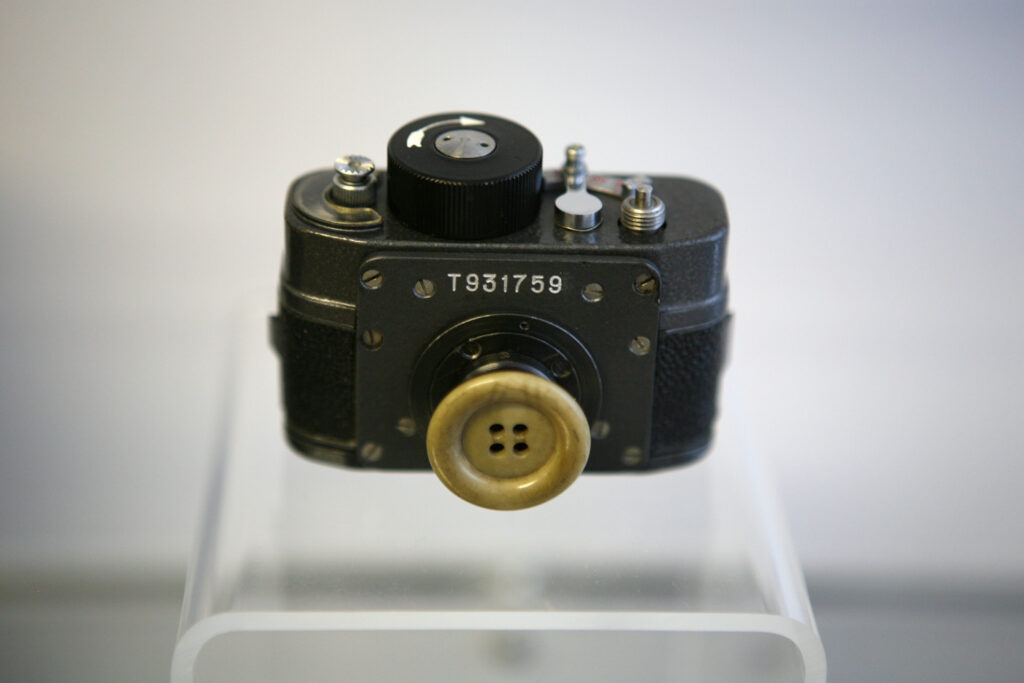
Buttonhole camera: The camera was in the clothing.
For camouflage, a matching button was screwed onto the lens.
Isolation was central to Zersetzung.
The objective was not necessarily to physically imprison someone.
It could be enough to make them increasingly disconnected from the people and organizations that gave their activism strength.
The Stasi Records Archive describes Zersetzung as a method intended to create uncertainty, dissatisfaction and public stigmatization and to undermine self-confidence.
The modern parallel
Digital life has created an unusual contradiction.
A person can be connected to thousands of people while becoming socially isolated in the physical world.
Online harassment can make someone withdraw.
Threats can discourage participation.
Persistent abuse can cause an activist to stop posting.
Doxxing can make someone afraid to attend public events.
Targeting family members can make the cost of activism feel too high.
The European Parliament has specifically noted threats against the families of human-rights defenders as part of the contemporary repression landscape.
Thus, modern isolation does not necessarily mean preventing somebody from communicating.
It can mean making communication too costly or dangerous to continue.
The Fifth Tactic: Psychological Pressure
Zersetzung was deliberately psychological.
The objective could include destroying self-confidence, creating uncertainty and making people question whether they should continue their activities.
That could occur through the accumulation of many relatively small pressures.
One event might not be decisive.
The problem was the pattern.
The modern parallel
Digital harassment creates a similar possibility of cumulative pressure.
A person may receive repeated hostile messages.
They may encounter waves of criticism.
Their personal information may be circulated.
They may constantly worry about account security.
They may receive threats or intimidating communications.
Their professional reputation may repeatedly become the subject of online controversy.
None of these automatically proves a coordinated campaign.
That qualification is essential.
But modern human-rights documentation recognizes online harassment and intimidation as genuine risks for activists and human-rights defenders.
The Sixth Tactic: Surveillance
The Stasi was fundamentally an intelligence organization.
Surveillance provided the information needed to understand people, organizations and relationships.
Without information, targeted interference was much harder.
The modern parallel
The contemporary surveillance environment is technologically different.
An activist’s digital life can contain:
- contacts;
- location information;
- photographs;
- private conversations;
- professional documents;
- browsing history;
- calendars;
- cloud files;
- and political activities.
Modern spyware can potentially provide extremely intrusive access to mobile devices.
The European Parliament has explicitly identified spyware such as Pegasus as an important tool in contemporary transnational repression and has also referenced hacking and other forms of digital surveillance.
That does not make every modern cybersecurity incident a political operation.
It does mean that the technological capacity for highly intrusive surveillance exists and has been documented in real cases.
The Seventh Tactic: Doxxing
Doxxing, the malicious publication of personal information, represents a particularly modern threat.
The Stasi had ways of obtaining and exploiting private information, but today’s information environment allows private details to be distributed at extraordinary speed.
An address, telephone number, workplace, photographs or details concerning relatives can potentially be copied and redistributed almost instantly.
The European Parliament explicitly lists doxxing among the tools involved in digital transnational repression.
The functional purpose can resemble older methods of intimidation: make the person feel exposed.
The Eighth Tactic: Blackmail and Compromising Material
The Stasi sought information that could be used to compromise individuals.
It could exploit private relationships, personal vulnerabilities and material damaging to a person’s reputation.
Today, the digital environment introduces enormous quantities of potentially compromising material.
Private photographs.
Messages.
Documents.
Passwords.
Financial information.
Personal correspondence.
A stolen account can contain years of material.
The European Parliament’s contemporary assessment identifies blackmail, intimidation and the malicious disclosure of personal information among forms of transnational repression.
The principle is familiar even though the technical environment is different: private information can become a tool of coercion.
The Ninth Tactic: Manipulating Public Perception
Zersetzung did not always require the target to know what was happening.
That was partly the point.
If an individual believed that their professional problems, friendships, and political difficulties were simply random events, it became harder to identify and confront the source of the pressure.
Modern information systems can create a different version of this problem.
An activist may encounter thousands of pieces of information every day.
Some are genuine.
Some are misleading.
Some are manipulated.
Some originate from anonymous accounts.
Some may be amplified artificially.
This makes information verification increasingly important.
The modern answer should not be to assume that everything is coordinated.
It should be to determine what can actually be established.
The Tenth Tactic: Using Institutions and Legal Pressure

Stasi spy camera, from the Stasi Museum in Berlin
The historical Stasi system operated within the institutions of an authoritarian state.
Its tools therefore included access to workplaces, administrative structures and coercive state mechanisms.
Modern repression can sometimes involve institutions in different ways.
The European Parliament’s 2025 resolution identifies contemporary abuses including strategic legal pressure, extradition procedures, politically motivated Interpol Red Notices, administrative restrictions and other institutional mechanisms in cases of transnational repression.
Again, this is not the same system as the GDR.
The political and legal contexts can be radically different.
But the underlying concept, using institutional mechanisms to increase pressure on a political opponent, is historically recognizable.
From Physical Networks to Digital Networks
Perhaps the most important difference between the Stasi era and the present is the infrastructure of communication.
The Stasi worked through physical spaces: churches, workplaces, universities, neighborhoods, meetings, telephone lines, postal correspondence, and human networks.
Modern activists operate simultaneously in physical and digital spaces.
A campaign may exist in a meeting room and on a social-media platform.
A journalist can publish from a phone.
A human-rights organization can coordinate internationally within minutes.
An activist can reach an audience across multiple countries without leaving home.
This gives civil society enormous new capabilities.
But it also gives adversaries new opportunities for surveillance and disruption.
The New Speed of Repression
A particularly important difference is speed.
Traditional covert operations often required planning, physical access and human intermediaries.
Digital operations can sometimes move almost instantly.
An account can be compromised.
A document can be copied.
A private photograph can be published.
A false claim can be distributed.
A website can be attacked.
Thousands of people can receive the material before the target has even understood what is happening.
That asymmetry is one reason contemporary digital security has become an important part of human-rights work.
Artificial Intelligence Adds Another Layer
The modern information environment is also being transformed by artificial intelligence.
AI can make the creation and dissemination of synthetic content easier, including manipulated images, audio, text and other material.
The European Parliament’s 2025 resolution specifically refers to AI-powered technologies as part of the emerging toolkit of digital transnational repression.
This does not mean every manipulated piece of content involving an activist is AI-generated.
It means that the barrier to producing convincing synthetic material is becoming lower.
That makes authentication, provenance and independent verification increasingly important.
What Has Not Changed
Despite all the technological differences, several underlying objectives remain familiar.
Surveillance
Then: physical observation, informants and intelligence files.
Now: digital surveillance, spyware, hacking and data collection.
Reputation
Then: rumors, deliberate disclosures and manipulated social information.
Now: disinformation, defamation, impersonation and online amplification.
Isolation
Then: social disruption and physical separation.
Now: harassment, doxxing, threats, intimidation and pressure against family members.
Psychological pressure
Then: uncertainty, disruption and engineered personal problems.
Now: persistent digital harassment, surveillance anxiety, threats and reputational attacks.
Organizational disruption
Then: infiltration, internal conflict and interference with meetings.
Now: compromised communications, online harassment, disinformation, account attacks and pressure on civil-society networks.
These are functional comparisons, not claims that the methods are identical.
What Has Changed Most: Scale
The modern Internet makes scale fundamentally different.
A Stasi operation could target an activist’s community.
A modern digital operation can potentially target an international audience.
The same characteristic that makes digital activism powerful also makes digital repression potentially powerful.
Information travels farther.
Faster.
Cheaper.
And sometimes anonymously.
That makes the protection of digital rights increasingly important.
Contemporary Documentation Is Not Speculation
This subject should be approached carefully.
There is a temptation to use the word Zersetzung for every unexplained problem involving an activist.
That is historically and analytically weak.
The Stasi’s Zersetzung system is known because there are documents.
There are directives.
There are operational plans.
There are archival files.
There are named organizations and documented targets.
The Pankow Peace Circle case is a particularly strong example because the Stasi Records Archive preserves the actual operational plan, including the objective of reducing the group’s activities and neutralizing its leaders.
Modern claims require the same discipline.
A suspicious event can be documented without immediately assigning its cause.
A cybersecurity incident can be investigated without assuming who was responsible.
A defamatory post can be preserved without assuming that it is part of a larger campaign.
The difference between documentation and speculation is crucial.
Human Rights Defenders and the Digital Age
The relevance of this subject today is not merely theoretical.
In April 2025, the UN Human Rights Council adopted Resolution 58/23, specifically addressing human-rights defenders and new and emerging technologies in the digital age.
Later in 2025, the European Parliament adopted its first dedicated resolution on transnational repression of human-rights defenders.
That resolution described transnational repression as a documented phenomenon and identified both physical and non-physical methods, including digital surveillance, intimidation and blackmail.
It also highlighted spyware, hacking, doxxing, online harassment, defamation and disinformation.
That is an important development.
It means that the risks facing activists in the digital age are not merely subjects for internet discussion.
They are recognized issues in contemporary European and international human-rights policy.
A Necessary Warning About Comparisons
Historical comparisons should still have limits.
The Stasi operated within a communist dictatorship.
Modern Europe contains constitutional protections, independent courts, democratic institutions, human-rights law and civil-society organizations.
A modern digital harassment campaign is therefore not automatically equivalent to Zersetzung.
The comparison becomes useful only when it asks a narrower question:
Are there modern mechanisms that can serve some of the same functional purposes, surveillance, intimidation, isolation, reputation damage or organizational disruption?
The evidence says that such mechanisms exist.
The European Parliament has explicitly documented many of them.
But identifying a contemporary mechanism is not the same as proving that a particular individual is experiencing a coordinated operation.
Why This History Matters
The history of Zersetzung teaches us something about the importance of transparency.
When power operates covertly, the person being targeted may have difficulty understanding what is happening.
That is why records matter.
Independent investigations matter.
Digital-security practices matter.
Archives matter.
Whistleblowers matter.
Journalism matters.
And legal protections for activists matter.
The Stasi archives make it possible to understand what happened decades later.
Modern societies should strive to create systems in which serious allegations can be investigated while events are occurring rather than becoming historical mysteries decades later.
Protecting Civic Space
The ultimate issue is bigger than one historical German term.
It is the right of people to participate in public life.
Human-rights defenders, journalists, activists, researchers, lawyers and civil-society organizations often perform functions essential to democratic accountability.
The European Parliament describes human-rights defenders as important to democracy, the rule of law and the protection of fundamental rights and has warned that they remain insufficiently protected against transnational repression.
The answer cannot be to assume that every threat is political.
Nor can it be to dismiss genuine threats simply because they occur online.
The appropriate response is evidence, legal protection, cybersecurity, independent oversight and accountability.
Conclusion
Zersetzung was a historically documented system of covert political repression.
The Stasi used infiltration, surveillance, rumors, reputation attacks, manipulation of relationships, psychological pressure, isolation and organizational disruption to weaken activists and opposition groups.
The modern world has not reproduced the Stasi system.
But technology has created new mechanisms through which some of the same broad objectives can be pursued.
Today, documented forms of repression against human-rights defenders can include spyware, hacking, digital surveillance, doxxing, online harassment, disinformation, blackmail, intimidation and legal pressure.
The European Parliament has explicitly identified these practices in its 2025 work on transnational repression.
The lesson is therefore neither “everything happening today is Zersetzung” nor “historical covert repression has nothing to teach us.”
The better lesson is:
Understand the history. Recognize the documented mechanisms. Protect civic space. Preserve evidence. And distinguish what can be demonstrated from what can only be suspected.
That is how history becomes useful without becoming a substitute for evidence.
Primary and contemporary sources
German Federal Archives / Stasi Records Archive — Pankow Peace Circle Zersetzung plan
Primary documentation of the 1983 Stasi operation against the Pankow Peace Circle.
Stasi Records Archive — Zersetzung documentation
Archival explanation of the objectives and methods of Zersetzung.
UN Human Rights Council — Resolution 58/23 (2025)
Resolution addressing human-rights defenders and new and emerging technologies in the digital age.
European Parliament — Addressing transnational repression of human rights defenders (2025)
Detailed documentation of contemporary methods including spyware, hacking, doxxing, online harassment, intimidation, defamation, disinformation, blackmail and legal pressure.
European Parliament — Study on transnational repression of human rights defenders (2025)
Research on the effects of transnational repression on civic space and human-rights defenders.