You don’t need an expensive recording studio to make music.
You don’t need a room full of vintage equipment.
You don’t need dozens of microphones, an enormous collection of hardware processors, or a record label paying for studio time.
Today, an independent artist can write, record, edit, mix, master and release an entire song from a bedroom with a computer, a microphone, headphones, and the right software.
That is exactly what makes modern independent music so exciting.
For me, making music independently means having the freedom to create whenever inspiration arrives.
I can write a song in the middle of the night, record an idea immediately, change an arrangement the next day, experiment with sounds, mix it myself, and eventually release the finished result without waiting for somebody else to give me permission.
My own approach is deliberately simple.
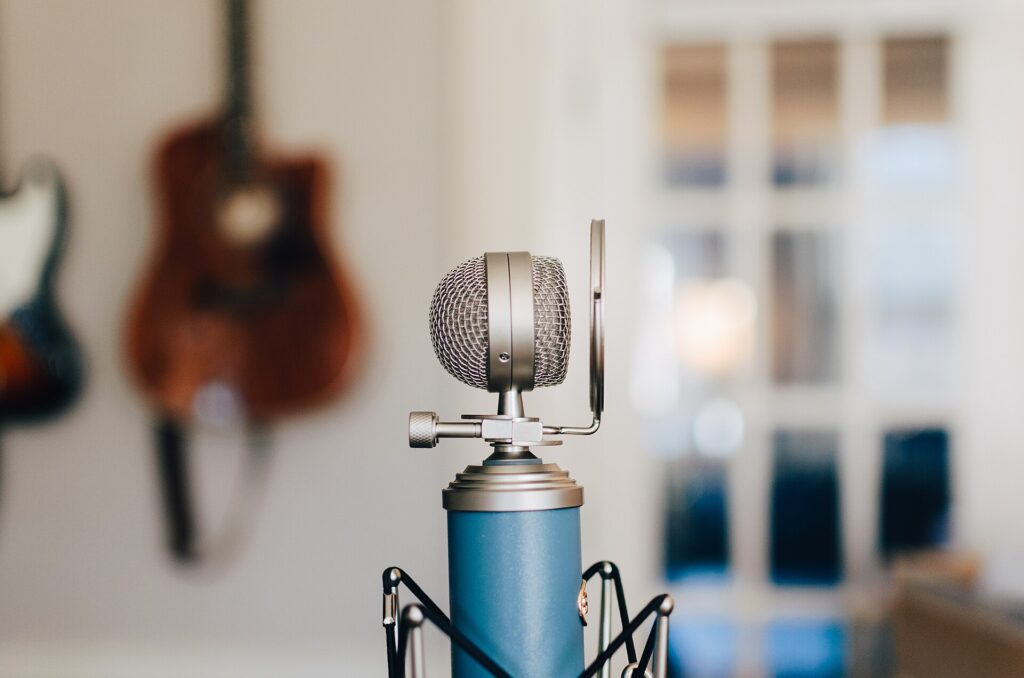
I work from home, use Mixcraft as my DAW, and use a Blue Microphones Bluebird as my main microphone.
The equipment is very minimal compared with a professional commercial studio.
But that does not mean the music has to be.
Your Bedroom Can Become a Studio
A bedroom isn’t acoustically perfect.
Most bedrooms have reflective walls, windows, furniture, hard surfaces and other characteristics that can make recording and mixing more difficult.
But a bedroom can still become a highly functional creative environment.
The most important thing is understanding what the room is doing to your sound.
A microphone does not only capture your voice.
It captures the room around you.
That means room treatment and microphone positioning can sometimes make a bigger practical difference than purchasing another expensive plugin or piece of equipment.
You don’t necessarily need a completely isolated recording booth.
You need to find the best part of your room and make the most of it.
Keep the Setup Simple
My basic approach demonstrates something I think every independent musician should remember:
You can make music without owning everything.
A minimal setup can consist of:
- a computer;
- a DAW;
- an audio interface;
- a microphone;
- headphones or monitors;
- and the instruments or virtual instruments needed for the song.
That’s enough to begin.
Everything beyond that is an enhancement.
You can gradually improve your setup as your skills and needs develop.
There is a danger in constantly buying equipment instead of making music.
It’s very easy to convince yourself that the next microphone, interface or plugin will finally make your recordings sound professional.
Sometimes better equipment genuinely helps.
But equipment cannot replace songwriting, performance, arrangement or engineering decisions.
Mixcraft as My DAW
For my own workflow, I use Mixcraft as my digital audio workstation.
A DAW is essentially the central environment where the music is created.
It allows me to: record audio; arrange tracks; edit performances; program instruments; apply effects; automate parameters; mix the song; and prepare the final production.
Mixcraft gives me the tools I need without forcing me to build an enormous and complicated workflow.
That’s important to me.
Technology should make creativity easier.
It shouldn’t become an obstacle.
The more complicated your setup becomes, the easier it is to spend hours configuring things instead of actually creating music.
A straightforward DAW workflow can help keep the focus on the song.
Why I Like a Practical Workflow
One of the advantages of working alone is speed.
I don’t need to schedule another studio session.
I don’t need to wait for someone else to become available.
I don’t need to explain an idea to a producer before trying it.
I can simply open the project and experiment.
An idea can become a guitar part.
A guitar part can become a verse.
A verse can become a complete arrangement.
And a complete arrangement can become a finished song.
That freedom is incredibly valuable.
The Bluebird Microphone
For vocals and other recordings, I use the Blue Microphones Bluebird.
The Bluebird is a large-diaphragm condenser microphone designed for studio recording.
A microphone is obviously only one part of the recording chain, but choosing a microphone that suits your voice and your room can make a significant difference.
For me, the Bluebird provides a practical way to capture vocals with enough detail for a full production workflow without requiring an enormous collection of microphones.
And that’s another important lesson:
You don’t necessarily need ten microphones when one good microphone can cover most of your needs.
Learn the microphone you own.
Learn how it responds to your voice.
Learn where to position it.
Learn how distance changes the sound.
Learn how the room affects the recording.
That knowledge can be more useful than continuously shopping for new gear.
Microphone Technique Matters
A good microphone can still produce a bad recording if it is used badly.
One of the simplest things you can control is distance.
Move closer and the voice generally becomes more intimate and can exhibit stronger proximity effect.
Move farther away and you capture more of the room and reduce some of that low-frequency proximity effect.
Small changes in angle can also help.
Turning slightly away from the microphone can alter plosive intensity and high-frequency energy.
The best position depends on the singer, the song, the room and the desired sound.
Recording is therefore partly an engineering exercise and partly an experiment.
Don’t Ignore the Room
Your bedroom doesn’t need to look like Abbey Road.
But you should pay attention to reflections.
A room full of hard, reflective surfaces can create unwanted reflections that reach the microphone shortly after the direct sound.
Those reflections can make vocals sound less focused and can make mixing decisions more difficult.
Soft furnishings, curtains, carpets, bookshelves and other irregular surfaces can help reduce some reflections.
However, randomly hanging blankets everywhere is not automatically the same as proper acoustic treatment.
The goal is to understand the acoustic problem and address it sensibly.
Record the Best Performance You Can
One of the biggest mistakes in home recording is trying to fix everything during mixing.
Editing is powerful.
Pitch correction is powerful.
Time correction is powerful.
But none of those things is a substitute for a strong performance.
The best starting point is still: a good song performed well into a reasonably good recording environment.
Take time to practice.
Warm up.
Learn the arrangement.
Know where the difficult phrases are.
Experiment with microphone distance.
Then record several takes.
Sometimes the final performance is a single take.
Sometimes it’s assembled from multiple takes.
There is nothing inherently wrong with either approach.
The goal is to create a convincing performance.
Recording in Layers
Modern DAWs make layering extremely accessible.
A song can contain: lead vocals; backing vocals; guitars; bass; drums; pianos; synths; percussion; effects; and atmospheric elements.
The challenge is knowing when to stop.
More tracks do not automatically mean a bigger or better song.
Sometimes one vocal and one instrument communicate more effectively than twenty layers.
Arrangement is therefore part of production.
Ask:
Does this part add something?
Does it improve the emotion?
Does it support the vocal?
Does it create contrast?
Does it make the chorus feel bigger?
If the answer is no, it might not need to be there.
Mixing in a Bedroom
Mixing in an untreated bedroom is difficult because the room can influence what you hear.
Low frequencies are especially problematic in small rooms.
You might hear too much bass at one position and too little somewhere else.
You can compensate through experience, reference tracks, headphones, and repeated listening on different systems.
One of the most useful habits is to check your mix everywhere.
Listen on: headphones; studio monitors if you have them; a phone; a car; small speakers; and ordinary consumer headphones.
The goal is not to make the mix sound perfect on one system.
The goal is to make it translate.
Reference Tracks Are Extremely Useful
When mixing independently, reference tracks can help prevent you from drifting too far away from a balanced production.
Choose commercially released songs that are reasonably similar in: genre; instrumentation; arrangement; and overall aesthetic.
Then compare.
How loud is the vocal?
How much low end is present?
How bright is the mix?
How wide are the instruments?
How much dynamic range is preserved?
Reference tracks don’t tell you exactly what to do.
They give you a reality check.
Learn Your Headphones
If you’re mixing primarily on headphones, learn their weaknesses.
Consumer headphones may have exaggerated bass or treble.
Different models can produce radically different impressions.
That doesn’t mean you can’t mix on them.
It means you have to understand them.
Use familiar recordings.
Listen repeatedly.
Learn how commercial mixes translate through the same headphones.
Over time, your brain becomes better at compensating for the characteristics of the playback system.
Plugins Are Tools, Not Solutions
One of the easiest traps for an independent producer is plugin addiction.
There are thousands of compressors, EQs, reverbs, saturators, limiters, tape emulations, amp simulations and mastering processors available.
You don’t need all of them.
A small collection of tools that you understand can be more useful than hundreds that you barely know.
You should be able to explain why you are inserting a plugin.
What problem are you solving?
What are you trying to change?
What are you listening for?
If you cannot answer those questions, the plugin may not be helping.
Mixing Is Mostly Decision-Making
It is easy to think of mixing as a collection of technical tricks.
But good mixing is fundamentally about decisions.
Which element should be louder?
Which sounds should occupy the center?
Where should the vocal sit?
How much low end does the song actually need?
Which instruments should be wide?
Where should the listener’s attention go?
Should the chorus sound more dense than the verse?
Production is storytelling through sound.
The technical tools simply allow you to make the decisions.
Don’t Chase “Perfect”
I can’t emphasize this strong enough.
This is something I believe strongly as both a musician and audio engineer.
A perfectly clean recording can still be boring.
Most of my songs include mistakes, and have an element of lo-fi to them.
An imperfect recording can still be emotionally powerful.
A slightly rough vocal can have personality.
A tiny timing imperfection can make a performance feel human.
A production doesn’t always need to sound clinically perfect.
It needs to serve the song.
That’s especially important for independent music.
You’re not necessarily competing on the size of your studio.
You’re competing on:
the quality of the song;
the emotion of the performance;
the creativity of the arrangement;
and the effectiveness of the production.
Bedroom Recording Can Actually Be an Advantage
There is another side to working from home.
The environment can become personal.
You’re recording in a place where you are comfortable.
You can experiment without somebody waiting for you to finish.
You can record a vocal take ten times without worrying about studio-hour costs.
You can stop.
Take a break.
Come back tomorrow.
Change everything.
Start again.
That freedom can produce music that feels more personal.
The limitations can even become part of the aesthetic.
The Independent Artist Has More Control Than Ever
Technology has fundamentally changed independent music.
A single artist can now: write; record; produce; mix; master; design artwork distribute; promote; and communicate directly with listeners.
You no longer need a traditional studio just to create a finished song.
You don’t necessarily need a record label to release one.
You don’t need a large production team to begin.
This doesn’t make the process easy.
It makes the process accessible.
The responsibility simply moves toward the artist.
You become the songwriter.
Producer.
Engineer.
Project manager.
Publisher.
Promoter.
And sometimes even the person fixing the computer when something stops working.
You Learn Faster When You Do Everything Yourself
Working independently has another major advantage: you learn.
When you record your own vocals, you learn microphones.
When you edit your own recordings, you learn timing and performance.
When you mix your own songs, you learn frequency balance and dynamics.
When you release your own music, you learn distribution.
When you market it, you learn communication.
Each stage teaches you something that can improve the next song.
Your tenth production should benefit from everything you learned on the first nine.
That’s one of the most rewarding parts of the process.
Don’t Let Gear Stop You
Perhaps the most important lesson is simple:
Start with what you have.
You can upgrade later.
If you have a laptop, a DAW, an interface, headphones and one microphone, you already possess a remarkable amount of creative power.
The limitations of your equipment can be frustrating.
But limitations can also force you to become more creative.
Learn the gear.
Learn the room.
Learn your DAW.
Learn your microphone.
Learn your voice.
Learn your instruments.
Then focus on writing better songs.
My Minimal Home-Studio Philosophy
My own philosophy is quite simple.
I would rather spend time making music than constantly researching equipment.
I would rather improve my engineering skills than buy another plugin.
I would rather write a memorable song than chase a technically perfect mix.
I would rather finish a project than leave hundreds of half-finished sessions on a hard drive.
And I would rather release something honest than wait forever for an imaginary version of perfection.
The equipment matters.
The software matters.
The engineering matters.
But the artist matters more.
From Bedroom to the World
The most amazing part of independent music today is what happens after the song is finished.
You can create the entire production in your bedroom.
Then upload it.
Distribute it.
Put it on streaming services.
Share the video.
Publish the lyrics.
Talk directly to listeners.
And suddenly a song made in one room can be heard by somebody thousands of kilometres away.
The room doesn’t determine the size of the audience.
The Internet can connect the two.
That is an incredible opportunity for independent musicians.
My Setup Is Minimal by Choice
I don’t consider a small setup a disadvantage.
A minimal system can be incredibly efficient.
For me, Mixcraft + the Bluebird + a computer + the rest of a simple home-studio chain provides enough flexibility to create complete songs.
The most important component isn’t the microphone.
It isn’t the DAW.
It isn’t the interface.
It isn’t the plugin collection.
It’s the idea.
Once you have an idea worth developing, the equipment becomes a means of bringing it into the world.
And that’s the real beauty of independent music.
You don’t need permission to begin.
You don’t need a million-dollar studio.
You need a song.
Conclusion
Making music from a bedroom used to sound like a compromise.
Today, it can be a legitimate production environment.
With a DAW such as Mixcraft, a capable microphone such as the Bluebird, a basic recording chain, good monitoring habits, and a willingness to learn, an independent artist can create surprisingly sophisticated music from home.
The equipment is only the beginning.
You still have to write the song.
You still have to perform it.
You still have to arrange it.
You still have to mix it.
You still have to make thousands of small creative decisions.
But that’s the point.
You can do it yourself.
You can build a song at two in the morning.
You can record a vocal take before breakfast.
You can spend an afternoon experimenting with a mix.
You can completely change the arrangement at midnight.
You can finish the master in the same room where the first lyric was written.
And then you can release it to the world.
That’s an extraordinary freedom.
So don’t wait for the perfect studio.
Don’t wait for the perfect microphone.
Don’t wait for someone to discover you.
Start with what you have.
Learn everything you can.
Make mistakes.
Finish songs.
Make more songs.
And let the music grow with you.
Your bedroom doesn’t have to be a limitation.
It can be where the journey begins.