Every year on 23 September, the European Union marks EU Organic Day, an annual occasion dedicated to raising awareness about organic production, supporting the people who work across the organic food chain, and highlighting the role that organic farming can play in a more sustainable European food system.
EU Organic Day is still a relatively new European observance. It was launched in 2021 by the European Parliament, the Council of the European Union and the European Commission, establishing 23 September as a day for promoting awareness of organic production and its importance across Europe.
But what exactly is the purpose of the day, and why has organic farming become an increasingly important part of European agricultural policy?
What Is EU Organic Day?
EU Organic Day is primarily an awareness and recognition day.
Its purpose is to give greater visibility to organic farming and organic production, encourage consumers to understand what the EU organic label represents, and recognise farmers, businesses, regions and organisations contributing to the development of the organic sector.
The day is closely connected with the EU’s wider efforts to develop organic agriculture. The European Commission’s Organic Action Plan is organised around three broad objectives: stimulating demand and consumer trust, encouraging production and strengthening the organic value chain, and improving the environmental contribution of organic farming.
In other words, EU Organic Day is not simply about celebrating organic food. It is also about the entire system behind it — farmers, processors, retailers, restaurants, consumers, certification bodies, researchers and rural communities.
Why Does Organic Farming Matter?
Organic farming is not simply a marketing term. Within the European Union, it operates under a specific legal framework.
EU rules establish production requirements, control systems and labelling provisions for organic products. Farmers and other operators who market products as organic must comply with the relevant rules and be subject to the EU’s certification and control system.
Organic production is designed to reduce reliance on synthetic chemical inputs and places particular emphasis on environmental protection. EU statistical definitions describe organic farming as a production method that places strong emphasis on environmental protection and, in livestock production, animal welfare.
The European Commission’s Organic Action Plan also highlights areas such as soil fertility, biodiversity, pollinators, animal welfare and resource efficiency as important elements of organic agriculture.
This does not mean that every organic farm is identical or that organic agriculture automatically solves every environmental problem. Farming methods involve trade-offs, and factors such as yields, transport, land use and local conditions still matter. What distinguishes organic production at EU level is that it is based on a defined regulatory and certification framework.
The EU Organic Logo
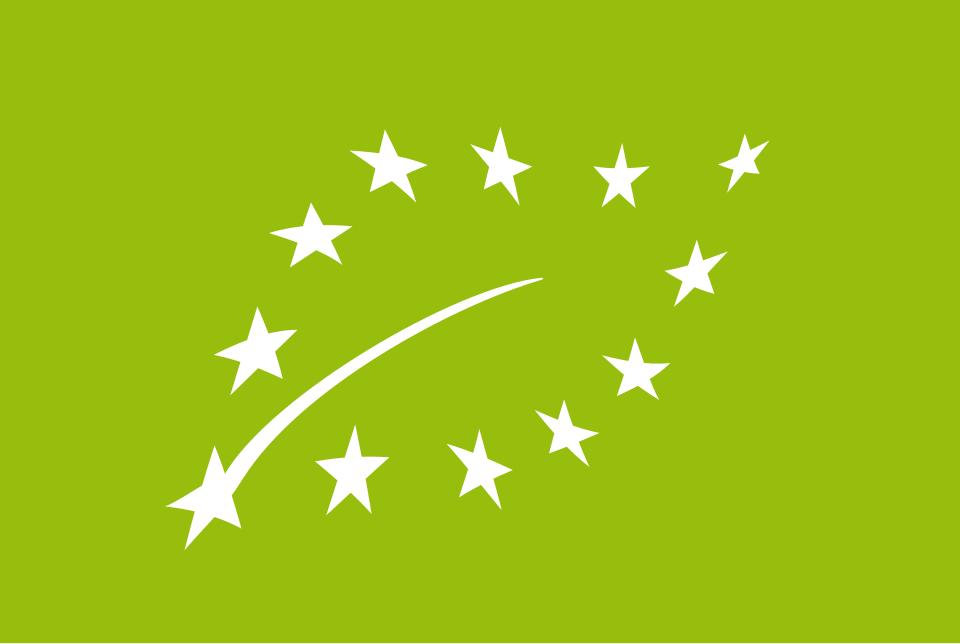
One of the most recognisable symbols associated with EU Organic Day is the EU organic logo, commonly known as the “Euro-leaf.”
The logo is used for products that comply with the applicable EU organic-production rules. The legislation also specifies how the logo is to be presented and allows it to be used for informational and educational purposes, provided it is not presented in a misleading way.
For consumers, the logo is therefore more than a decorative green symbol. It is intended to communicate that the product is part of the EU’s regulated organic-production system.
That distinction is important because the word “organic” can otherwise be used very loosely in everyday conversation.
Europe Is Moving Toward More Organic Agriculture
Organic farming has expanded considerably across Europe over the past decade.
According to Eurostat’s 2026 edition of Key Figures on Europe, more than 16.8 million hectares in the EU were fully converted to organic farming or were undergoing conversion in 2024. This represented approximately 10.6% of the EU’s utilised agricultural area.
A separate Eurostat indicator measuring the share of agricultural land under organic farming puts the EU figure at about 11% in 2024, compared with 8.5% in 2019.
These figures are significant because the EU has established a longer-term objective of reaching at least 25% of agricultural land under organic farming by 2030.
That target means that organic agriculture is no longer treated as a small niche within European agriculture. It is part of a much larger discussion about how food should be produced, how rural economies can be supported, and how environmental objectives can be incorporated into agriculture.
What About Croatia?
Croatia is also part of this European transition.
Eurostat’s 2026 monitoring data show that approximately 9% of Croatia’s utilised agricultural area was under organic farming in 2024. Eurostat also reports that Croatia experienced growth of more than 10% in organic crop area between 2023 and 2024.
Croatia has therefore seen substantial long-term growth in organic agriculture. Eurostat previously reported that the area used for organic farming in Croatia increased by more than 300% between 2012 and 2022.
For a country with significant agricultural, rural and natural landscapes, the development of organic production can also be viewed in the context of local food systems, rural development and biodiversity.
EU Organic Awards
One of the most visible activities associated with EU Organic Day is the EU Organic Awards.
The awards were first presented in 2022 and recognise achievements across the organic value chain. The current awards structure includes categories for organic farmers, regions or bio-districts, cities, food processors, retailers and restaurants or food-service operators.
The purpose of the awards is not simply to celebrate individual businesses. They are intended to showcase examples of innovation and sustainable practice and to give greater visibility to the people and organisations working to develop organic production and consumption.
The fifth EU Organic Awards are being presented on EU Organic Day 2026, 23 September, in Brussels.
More Than a Label
One of the most interesting things about EU Organic Day is that it encourages people to look beyond the finished product.
A jar of organic food, a bottle of organic wine, a box of vegetables or a piece of organic produce represents a much larger chain of activity. Behind the final product are farming decisions, soil management, animal husbandry where relevant, processing, certification, transportation, retail and ultimately consumer choice.
That is why the European Commission places such emphasis on consumer trust. Organic agriculture depends not only on farmers being willing to produce organically but also on consumers understanding what the certification system means and having confidence that the rules are being followed.
In this respect, EU Organic Day has an educational role as much as a celebratory one.
Why 23rd of September Matters
The significance of EU Organic Day ultimately goes beyond one day in the calendar.
It represents an ongoing European conversation about food, agriculture, rural communities and the environment. Organic farming is one part of that conversation, operating alongside many other approaches to sustainable agriculture.
The annual observance provides an opportunity to recognise farmers and producers, learn more about organic standards, understand the EU organic logo and consider how food-production choices affect the land and communities around us.
For consumers, it can be as simple as paying attention to the labels on the products they buy.
For farmers and producers, it is an opportunity to have their work recognised.
And for Europe as a whole, it is a reminder that the future of agriculture is not only about how much food is produced, but also about how that food is produced and what kind of agricultural system Europe wants to build for the future.
EU Organic Day, held every 23 September, puts that discussion into focus once a year, while the much larger challenge of transforming agriculture continues throughout the rest of the year.